INTER GLOBAL TRADERS







Sunflower
Sunflower (Helianthus annuus L.), one of the most ancient oilseed species in North America, belongs to the family Compositae (Asteraceae) and the genus Helianthus. Cultivation of sunflower dates from times earlier than 3000 B.C. It appears that sunflower was domesticated in America even before corn was. It was introduced into Europe by the Spanish explorers at the beginning of the 1500s A.D. Starting from Spain, sunflower crops spread rapidly through France and Italy, and toward the north and east of Europe.
Sunflower is a highly cross-pollinated, annual crop. Plants reach 1-3 m in height. Sunflower heads follow the sun cycle until practically all flowers comprising the head have been pollinated. After that, they remain in a fixed position, facing eastward. Around 70 days are required from sowing to flowering of the crop. Seeds reach maturity at 130 days and can be harvested 10 days later.
Sunflower grows in moderate climates, especially in America, Europe and China. It grows well in dry, sunny weather, in deep soils capable of supplying abundant water. The oil content of seeds is lower in regions of extreme heat. The crop has high resistance to temperature fluctuations between night and day. The oil content of sunflower seeds varies also during the development of the seed. After reaching maturity the oil content remains steady. Ambient factors, such as temperature and light, affect the oil composition of sunflower seeds, as well.
Sunflower oil
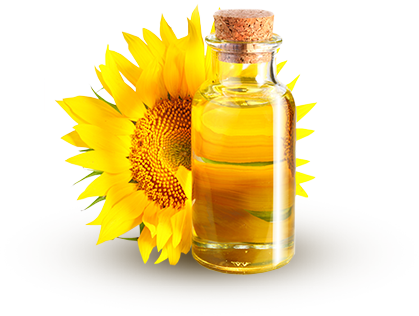
Sunflower oil is the non-volatile oil obtained from Helianthus annus grown mainly in Russia, Argentina, Western and Eastern Europe, China, and the United States. The oil normally contains 60-75% of linoleic acid, >90% of oleic and linoleic acids combined, and virtually no linolenic acid. Its major triacylglycerols are typically LLL (14%), LLO (39%), LLS (14%), LOO (19%), LOS (11%), and other (3%). It also contains lecithin, tocopherols, carotenoids and waxes. Its properties are typical of a vegetable triglyceride oil. Sunflower oil is light in taste and appearance and has a high vitamin E content. It is a combination of monounsaturated and polyunsaturated fats with low saturated fat levels.
Sunflower oil was first industrially produced in 1835 in the Russian Empire. The world's largest sunflower oil producers now are Ukraine and Russia. Sunflower oil is one of the healthiest and popular oils in the world. It is often considered a premium oil due to its light colour, mild flavour, low level of saturated fat and ability to withstand high cooking temperatures. It is an excellent household oil great for baking and frying, even as a salad oil. It is used also in cosmetic formulations as an emollient. It may also provide a protective barrier that resists infection in premature infants.
Sunflower oil is usually extracted through pressing of the seed and later extraction by solvent. The crude oil is usually subjected to traditional refining stages. Cold-pressed sunflower oil is currently valued as a new extra virgin oil. Extraction of sunflower oil is generally carried out in two stages. The first stage consists of mechanical extraction using screw-presses (expellers). The meal obtained in the pressing stage, containing 15-20% of oil, is subjected to extraction by solvent (normally hexane). The solvent must then be eliminated from both meal and oil. Oils obtained through pressing are of better quality than those obtained by solvent extraction. However, both are blended before storage.
Refining sunflower oil through solvent extraction, degumming, neutralization and bleaching can make it more stable and suitable for high-temperature cooking, but will also remove some of the oil's nutrients and flavour, including colour pigments, free fatty acids, phospholipids, polyphenols and phytosterols. Unrefined sunflower oil is less heat stable, but will retain more of its original nutrient content and flavour, and is well suited to dishes that require low- or no- heat.
Because sunflower oil is primarily composed of healthier but less stable polyunsaturated and monounsaturated fatty acids, it can be particularly susceptible to damage by heat and light. Several general factors affect the oxidative stability of sunflower oil during storage. One of these factors is the degree of unsaturation. Product shelf-life is affected by manufacturing conditions such as the type of extraction process (pressing, with solvent, with supercritical fluids), degree of purification (crude, refined, deodorized, etc.), addition of antioxidants, and type of packaging (container material, incorporation of inert atmosphere, etc.). Other major factors influencing the oxidative stability are the particular storage conditions: time, temperature, and light, among others.
Sunflower oil - energy source
Sunflower oil has been researched as a potential diesel substitute, with sunflower oil having the energy equivalent to 93% of # 2 U. S. diesel fuel. In the future, sunflower oil could also become a renewable bio-source for hydrogen. To date, however, the extraction process “costs” more energy than the hydrogen liberated would provide. Sunflower oil is also processed and used as lubricants in machinery, including automobiles. Additionally, experiments have shown that sunflower oil could be turned into plastic materials such as vinyl and latex
Sunflower (Helianthus annuus L.), one of the most ancient oilseed species in North America, belongs to the family Compositae (Asteraceae) and the genus Helianthus. Cultivation of sunflower dates from times earlier than 3000 B.C. It appears that sunflower was domesticated in America even before corn was. It was introduced into Europe by the Spanish explorers at the beginning of the 1500s A.D. Starting from Spain, sunflower crops spread rapidly through France and Italy, and toward the north and east of Europe.
Sunflower is a highly cross-pollinated, annual crop. Plants reach 1-3 m in height. Sunflower heads follow the sun cycle until practically all flowers comprising the head have been pollinated. After that, they remain in a fixed position, facing eastward. Around 70 days are required from sowing to flowering of the crop. Seeds reach maturity at 130 days and can be harvested 10 days later.
Sunflower grows in moderate climates, especially in America, Europe and China. It grows well in dry, sunny weather, in deep soils capable of supplying abundant water. The oil content of seeds is lower in regions of extreme heat. The crop has high resistance to temperature fluctuations between night and day. The oil content of sunflower seeds varies also during the development of the seed. After reaching maturity the oil content remains steady. Ambient factors, such as temperature and light, affect the oil composition of sunflower seeds, as well.
Sunflower oil
Sunflower oil is the non-volatile oil obtained from Helianthus annus grown mainly in Russia, Argentina, Western and Eastern Europe, China, and the United States. The oil normally contains 60-75% of linoleic acid, >90% of oleic and linoleic acids combined, and virtually no linolenic acid. Its major triacylglycerols are typically LLL (14%), LLO (39%), LLS (14%), LOO (19%), LOS (11%), and other (3%). It also contains lecithin, tocopherols, carotenoids and waxes. Its properties are typical of a vegetable triglyceride oil. Sunflower oil is light in taste and appearance and has a high vitamin E content. It is a combination of monounsaturated and polyunsaturated fats with low saturated fat levels.
Sunflower oil was first industrially produced in 1835 in the Russian Empire. The world's largest sunflower oil producers now are Ukraine and Russia. Sunflower oil is one of the healthiest and popular oils in the world. It is often considered a premium oil due to its light colour, mild flavour, low level of saturated fat and ability to withstand high cooking temperatures. It is an excellent household oil great for baking and frying, even as a salad oil. It is used also in cosmetic formulations as an emollient. It may also provide a protective barrier that resists infection in premature infants.
Sunflower oil is usually extracted through pressing of the seed and later extraction by solvent. The crude oil is usually subjected to traditional refining stages. Cold-pressed sunflower oil is currently valued as a new extra virgin oil. Extraction of sunflower oil is generally carried out in two stages. The first stage consists of mechanical extraction using screw-presses (expellers). The meal obtained in the pressing stage, containing 15-20% of oil, is subjected to extraction by solvent (normally hexane). The solvent must then be eliminated from both meal and oil. Oils obtained through pressing are of better quality than those obtained by solvent extraction. However, both are blended before storage.
Refining sunflower oil through solvent extraction, degumming, neutralization and bleaching can make it more stable and suitable for high-temperature cooking, but will also remove some of the oil's nutrients and flavour, including colour pigments, free fatty acids, phospholipids, polyphenols and phytosterols. Unrefined sunflower oil is less heat stable, but will retain more of its original nutrient content and flavour, and is well suited to dishes that require low- or no- heat.
Because sunflower oil is primarily composed of healthier but less stable polyunsaturated and monounsaturated fatty acids, it can be particularly susceptible to damage by heat and light. Several general factors affect the oxidative stability of sunflower oil during storage. One of these factors is the degree of unsaturation. Product shelf-life is affected by manufacturing conditions such as the type of extraction process (pressing, with solvent, with supercritical fluids), degree of purification (crude, refined, deodorized, etc.), addition of antioxidants, and type of packaging (container material, incorporation of inert atmosphere, etc.). Other major factors influencing the oxidative stability are the particular storage conditions: time, temperature, and light, among others.
Sunflower oil - energy source
Sunflower oil has been researched as a potential diesel substitute, with sunflower oil having the energy equivalent to 93% of # 2 U. S. diesel fuel. In the future, sunflower oil could also become a renewable bio-source for hydrogen. To date, however, the extraction process “costs” more energy than the hydrogen liberated would provide. Sunflower oil is also processed and used as lubricants in machinery, including automobiles. Additionally, experiments have shown that sunflower oil could be turned into plastic materials such as vinyl and latex
© 2014 Inter Global Traders